Identify progression
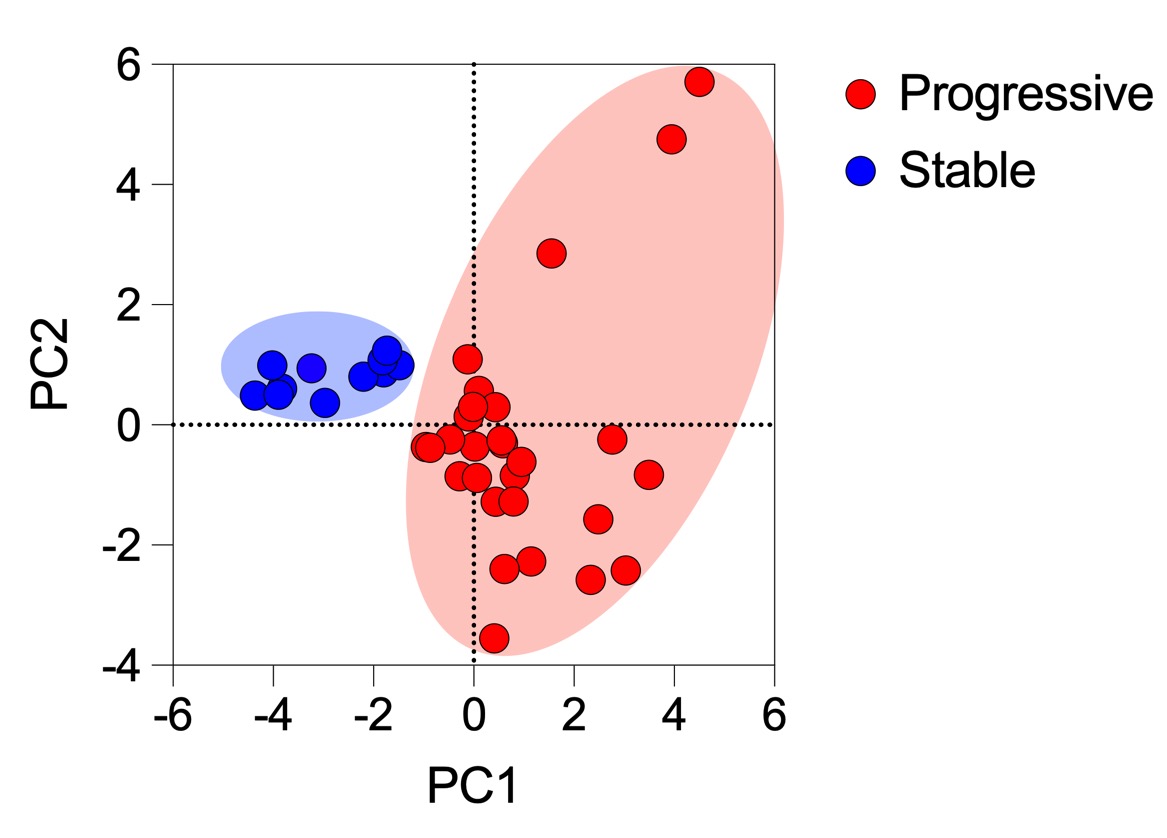
Investigate objective molecular differences between progressive and clinically stable MS.
A YALE SPINOUT / NEUROLOGICAL BIOMARKER RESEARCH
AstroScope combines dozens of RNA biomarkers from astrocyte-enriched blood vesicles into signatures of neurological disease, progression, and drug response.
For biopharma teams, the platform brings a molecular view of neurological disease into biomarker and clinical-trial research. Secondary progressive MS is our lead program, validated for research use, with development toward clinical use continuing.
Research use only. Not for clinical diagnostic use.

01 / THE PROBLEM IN NEUROLOGY
Measuring disease biology in living patientsSymptoms and imaging reveal important aspects of neurological disease. Drug developers also need accessible ways to investigate the molecular biology driving progression and differences in treatment response.
Blood contains vesicles from many tissues. AstroScope enriches a cell-associated fraction to investigate CNS-related signals within that mixture. Our first application addresses the challenge of recognizing MS progression.
The platform is designed to support disease-specific signatures on a shared sample-processing and analysis foundation—allowing research across neurological conditions.
The research need behind the Colton project ↗Investigate objective molecular differences between progressive and clinically stable MS.
Study whether a blood sample contains signals associated with later clinical progression.
Explore how disease biology and treatment exposure relate to RNA signatures over time.
02 / THE ASTROSCOPE PLATFORM
CNS-focused enrichment → dozens of biomarkers → disease-specific signatures
AstroScope combines dozens of RNA biomarkers from astrocyte-associated vesicles in blood. AI identifies patterns linked to CNS disease, progression, and treatment response.
MS is validated for research use; clinical development continues.
Read the Yale technology overview ↗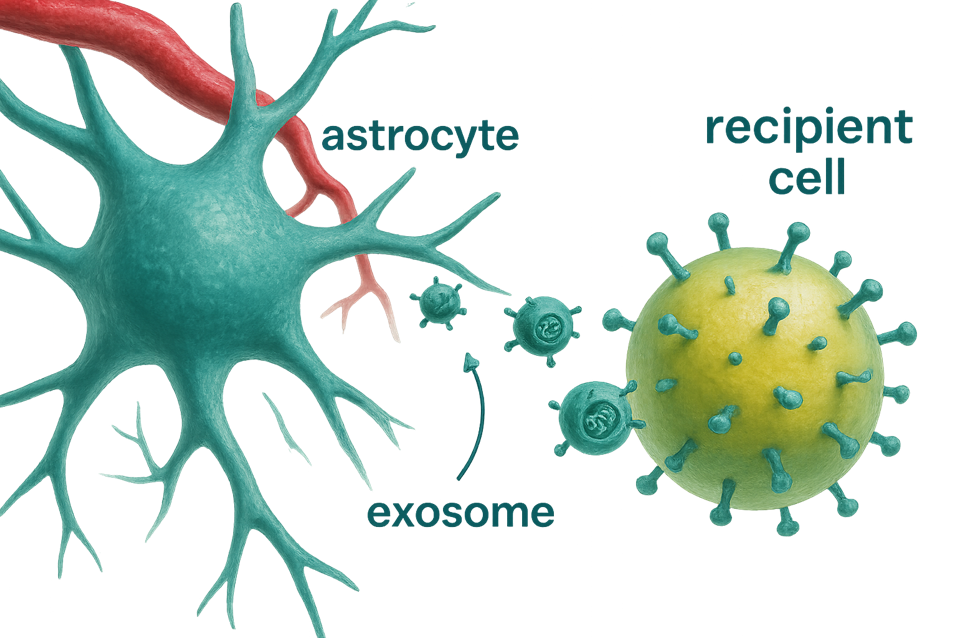
WHAT IS AN EXOSOME?
Exosomes are small extracellular vesicles released by cells. They carry molecules, including RNA and proteins, that can reflect the state of the cells that released them.
Astrocytes support neurons, connect with blood vessels, and play key roles in disease and repair. A single human astrocyte can span up to two million synapses.
Biomarkers working in unison can reveal patterns that individual markers miss. By focusing on astrocyte-associated signals, AstroScope narrows the analysis to questions relevant to CNS disease.
Read our team’s review of CNS exosome biomarkers ↗HOW ASTROSCOPE WORKS
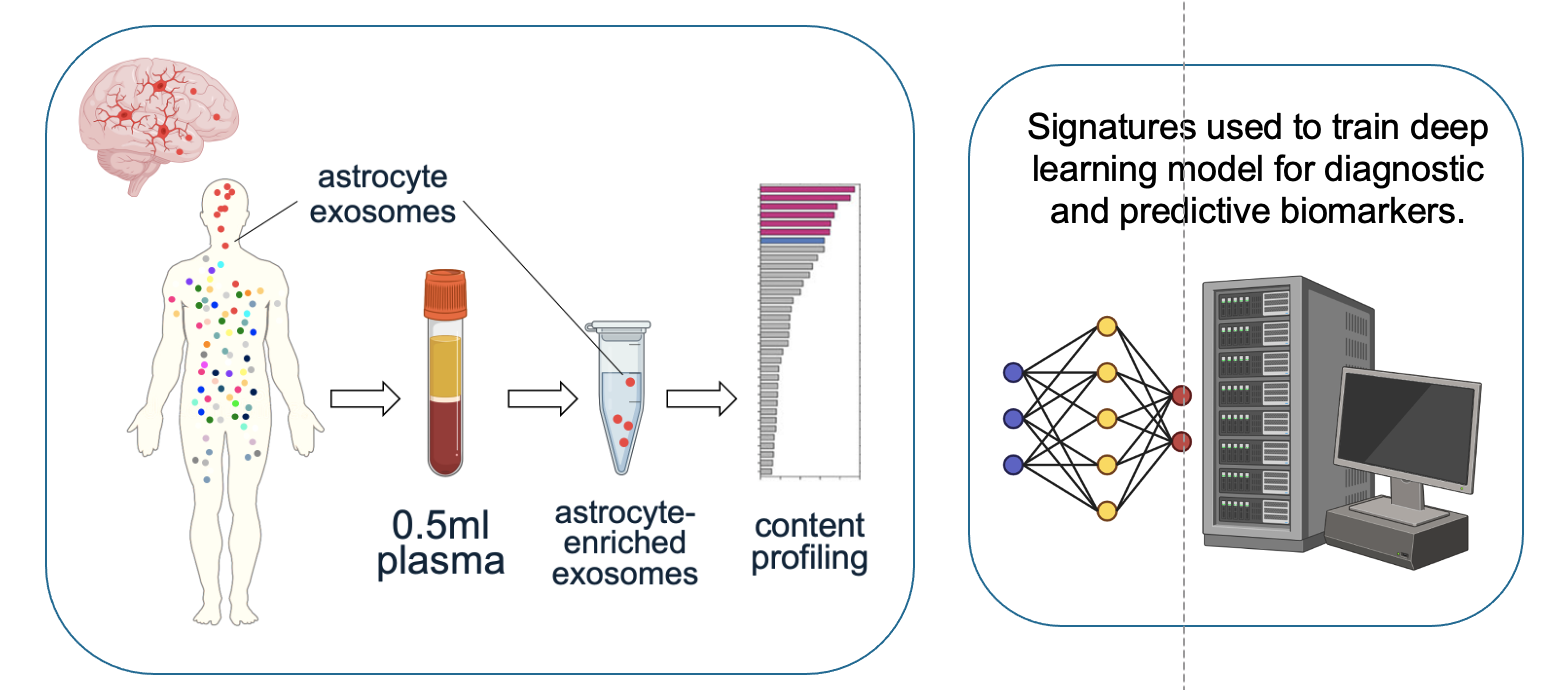
The workflow combines sample processing, vesicle enrichment, RNA profiling, and study-specific analysis. It is currently a research tool.
Collect a blood sample and prepare plasma or serum.
INPUT / PLASMA OR SERUMAstroScope isolates astrocyte-marker–labeled exosomes from plasma or serum.
OUTPUT / ENRICHED EV FRACTIONExtract and measure vesicle RNA cargo. Dozens of disease-specific, cell-specific markers are isolated.
OUTPUT / RNA PROFILEUse AI modeling, including machine learning, to discover patterns across dozens of RNA biomarkers.
OUTPUT / COMBINED BIOMARKER SIGNATUREIdentify diagnostic, predictive, prognostic, and drug-response signatures, including signals of disease change and progression rate.
OUTPUT / SIGNATURES FOR DEFINED RESEARCH QUESTIONSEnrichment does not imply absolute cell specificity. Methods and deliverables are study-specific. AstroScope is not currently offered for clinical diagnosis.
ONE PLATFORM / MULTIPLE PROGRAMS
AstroScope is a platform for discovering biomarkers and signatures across many diseases.
As new questions arise, comparisons between patient groups, disease states, and treatment responses can uncover new signals.
How the platform supports partnerships →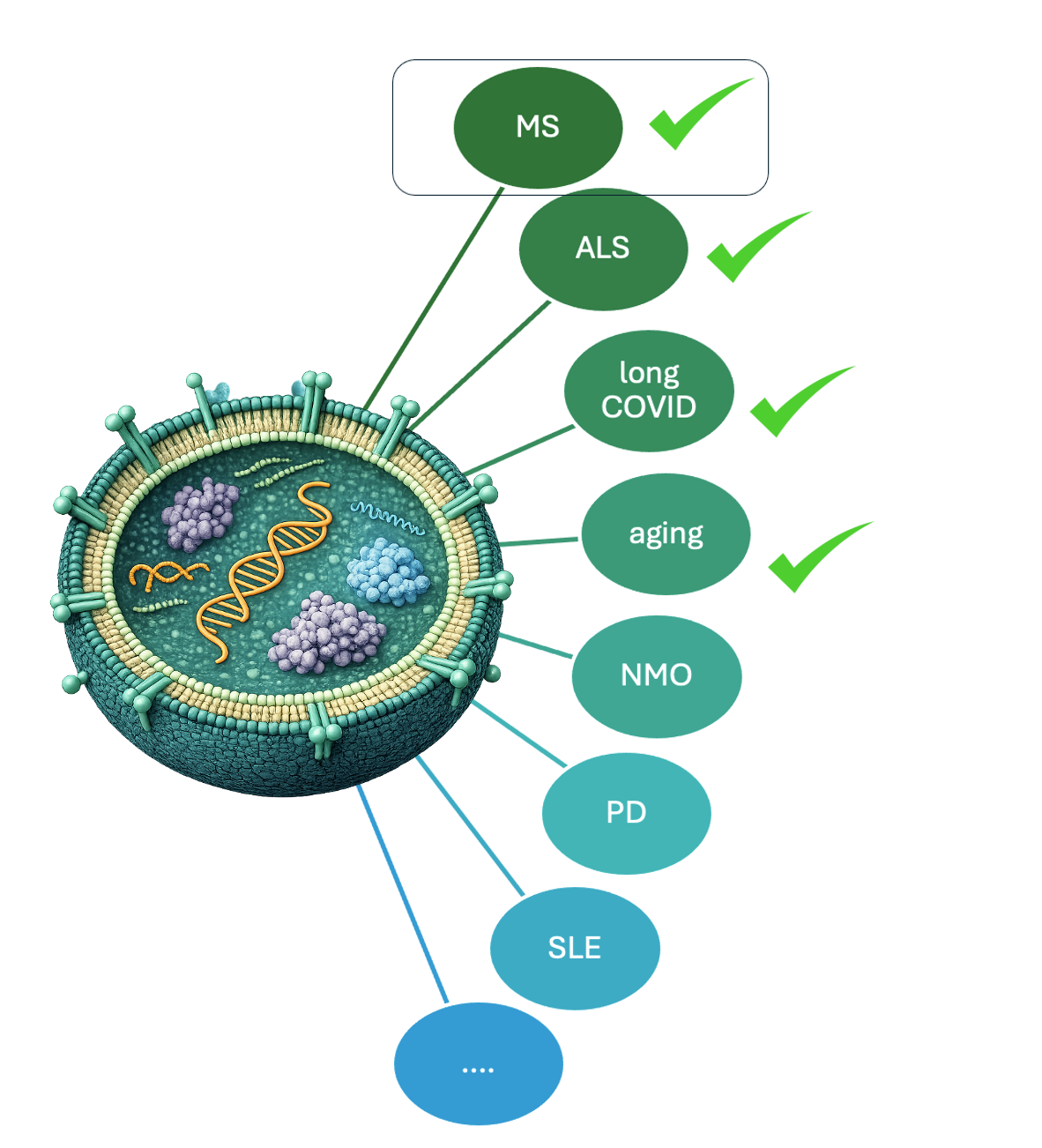
DEVELOPMENT PIPELINE
Each program advances through discovery, research validation, and study-specific development. Clinical products require additional evidence and the applicable regulatory pathway.
| Program | Discovery | Research validation | Trial integration | Clinical product |
|---|---|---|---|---|
| Progressive MSLEAD PROGRAM | Signature identified | Validated for RUO | In development | Clinical work continues |
| ALS | Signature identified | Research underway | In development | Not established |
| Brain aging | Signature identified | Early research | Not established | Not established |
| Long COVID | Signature identified | Early research | Not established | Not established |
| NMOSD / NMO | Exploratory | Not established | Not established | Not established |
| Remyelination | Exploratory | Not established | Not established | Not established |
MS is validated for research use. Validation continues for the other discovery programs. Clinical products require additional evidence and regulatory review.
03 / SPMS PROGRAM & REPORTED DATA
MS validated for RUO / Clinical development continuesOur lead program focuses on secondary progressive multiple sclerosis (SPMS) and is validated for research use. Work toward clinical use continues.
We are investigating blood-based molecular signatures that may help researchers identify MS progression and study signals that precede clinical recognition.
Discuss the SPMS programMS / RESEARCH-USE VALIDATION
Identifying MS progression
Predicting MS progression two years before a physician
Company-described studies use blinded retrospective analyses of previously collected samples from prospective Phase III randomized controlled trials.
AUC measures how well a model separates groups; it is not percentage accuracy. These are company-reported research findings, with publications pending. They do not establish prospective clinical utility.
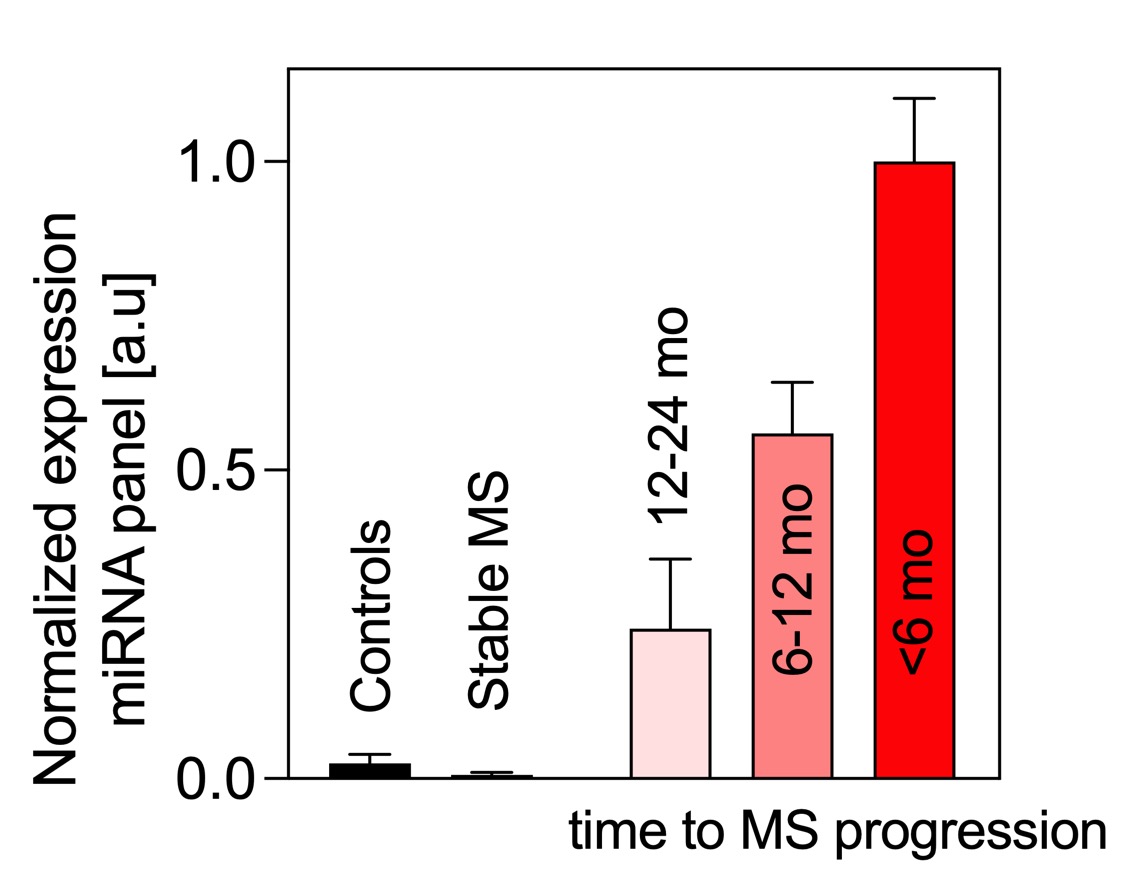
STUDY CONTEXT
Blinded retrospective analyses of Phase III trial samples linked AstroScope exosomal microRNA signatures to MS progression, including progression 18–24 months after blood collection.
Source: East Rock Diagnostics research presentations · Research use only · SPMS publications pending.
WHY IT MATTERS
For people living with MS, changes in walking, balance, and fatigue can affect daily routines and independence. These are the everyday stakes behind the search for better ways to understand progression.
East Rock’s goal is to give researchers—and, with further clinical validation, care teams—the tools for better clinical decisions by patients and physicians.

WHY THE DECISION GAP MATTERS
Disability can accumulate after relapses and independently of relapse activity. A quieter relapse history does not, by itself, answer whether underlying disability is progressing.
AstroScope’s lead research program asks whether a molecular signature can help distinguish progressive from stable MS and flag later progression.
Read the clinical evidence on relapse-independent progression ↗Clinical worsening occurs in relation to a relapse.
Longitudinal measurements are needed to recognize and confirm progression.
INTENDED CLINICAL USES IN MS
STABLE PATIENTS
Nearly one-third of secondary progressive MS patients are stable. Support decisions to stop unnecessary treatment in patients with stable MS.
PROGRESSIVE PATIENTS
About two-thirds of secondary progressive MS patients will progress. Identify the patient subpopulation most likely to benefit from treatment aimed at preventing progression.
TREATMENT RESPONSE
Monitor responses to help assess whether treatment should continue, change, or stop.
AstroScope is currently for research use only. These clinical applications require further validation.
04 / BUSINESS MODEL & MARKET
Available now: RUO analysis and research collaborationsEast Rock offers paid research-use sample analysis and collaborative biomarker studies for biopharma teams developing neurological therapies.
01 / PHARMA SERVICES
Sponsored research and trial partnerships generate revenue with existing signatures
Available now
Research services & collaborations
02 / MS CLINICAL DEVELOPMENT
Validate and launch a clinical test
Planned path
Clinical product development
03 / INDICATION EXPANSION
Identify new signatures
Selection criteria
Evidence, need & market size
NEW PROGRAMS → NEW PHARMA PARTNERSHIPSMore revenue and trial data support the next cycle.
Exosome enrichment → RNA profiling → Analysis
TRIAL DESIGN
Stratify patients, balance treatment arms, and identify potential responder subpopulations.
EARLY BIOLOGICAL RESPONSE
Use early molecular changes to inform trial decisions and investigate target engagement and mechanism of action.
TRIAL OUTCOMES
Track treatment response and progression using molecular signatures as study-specific research outcomes.
MARKET OPPORTUNITY
AstroScope connects biomarker research for neurological drug development with future disease-specific diagnostic testing.
Global market by application, 2023–2033.
Pharma and biotech account for about half of the supplied 2024 market view.
Rounded proportions from the supplied graphic; exact segment shares remain unconfirmed.
The original pie has no numeric share labels. The displayed 1/2 / 1/3 / 1/6 split is a rounded visual estimate, not an exact publisher data table. Grand View Research’s indexed pharma/biotech figure of $4,565.8M supports a share of about half of the $9.1B total; other publisher pages give conflicting end-use descriptions. Exact shares require reconciliation before an unqualified presentation.
Publisher’s pharma/biotech data ↗ · 2025 press release ↗Global market by drug type, from the supplied 2022–2032 forecast.
Drug-market context for biopharma partnerships; excluded from East Rock’s diagnostic opportunity. This historical forecast is not presented as a current market estimate.
| Year | Market size |
|---|---|
| 2022 | 28.2 |
| 2023 | 29.3 |
| 2024 | 30.2 |
| 2025 | 31.7 |
| 2026 | 33.1 |
| 2027 | 34.1 |
| 2028 | 34.9 |
| 2029 | 36.3 |
| 2030 | 37.5 |
| 2031 | 38.9 |
| 2032 | 41 |
The company’s initial model starts with US patients over age 45 and assumes full use of one to two assays per year.
680,000 over age 45
68% of the modeled population
MODELED ANNUAL US OPPORTUNITY
$1.7–3.4BThe original slide assumes a fourfold global multiplier. Applied to the unrounded US calculation, it gives $6.8–13.6B per year. This is a company scenario, not an independently sized global market. Country-specific eligibility, access, use, and pricing are not modeled.
Source: East Rock company presentation, slide 10; assay-price assumption updated to $2,500 by the company, October 2026. Population, testing frequency, price, and global multiplier are company assumptions. Final AstroScope pricing has not been set; clinical availability, adoption, reimbursement, and eligibility determine realized revenue. View original ↗
The separate broader company model uses 1.2 million US patients × two assays per year × $2,500 per assay, giving $6 billion annually at full modeled utilization.
These are company projections, not current revenue. Clinical availability and access are assumed.
Discuss available samples, clinical annotations, the analysis plan, and research deliverables with our team.
Endpoint roles, analysis plans, and interpretation are defined for each study and its intended research use. Clinical diagnostic products remain in development.
05 / SCIENTIFIC FOUNDATION
Grounded in research. Built for what comes next.AstroScope grew from research at Yale. Public recognition of the underlying work provides a foundation for the next stage of investigation.

David Pitt and co-investigator Jonathan Weerakkody recognized for work on exosomal RNA biomarkers of MS progression.
Read Yale’s announcement
David Pitt’s AstroScope neurodiagnostic platform appears among Yale’s 2026 Development Awardees.
Explore the award listingJonathan Weerakkody’s award supports research on glial-derived extracellular vesicle RNA signatures in MS.
Read the Yale announcementAwards above recognize the investigators and research projects at Yale. They do not imply institutional endorsement of East Rock Diagnostics.
SELECTED PUBLICATIONS
Research publications / Not validation of the SPMS results aboveSPMS publications pending. Manuscript titles and public citations will be added when available.
06 / COMPANY & PEOPLE
Neuroscience, assay development, and biopharma partnershipsEast Rock Diagnostics Inc. is a Yale spinout and pre-seed diagnostics company translating extracellular vesicle research into tools for neurological biomarker studies.
Our team combines MS clinical expertise, vesicle and RNA assay development, and research partnerships across biopharma and academia. We have access to world-class clinical data and patient biosamples from Yale Neurology and the MS clinic, as well as the MS Brain Bank.
COMPANY STRATEGY & PARTNERSHIPS
Chief Executive Officer & Co-founder
Ilir Topalli leads East Rock Diagnostics’ company strategy and biopharma partnerships. He brings experience across neuroscience, medical affairs, and academic–industry research collaboration, with a longstanding focus on multiple sclerosis. He previously served as President of Alison Pharmaceuticals Inc. Ilir is a biotech analyst and investment advisor for e*Healthline.
At Bristol Myers Squibb, he served as Global Academic Research Collaborations Lead within Worldwide Strategic Collaborations. Previously, he was National Scientific Director, Scientific Partnerships at Biogen, where he led the US investigator-initiated research program across the neurology portfolio. At MedDay Pharmaceuticals, he directed global medical sciences and evidence-generation activities supporting a Phase III progressive MS program.
Ilir holds a PhD in Neuroscience from Albert Einstein College of Medicine. At East Rock, he connects the platform’s scientific development with the needs of research partners and the company’s path to commercialization.

CLINICAL & TRANSLATIONAL SCIENCE
Co-founder
David Pitt is a clinician-scientist and Associate Professor of Neurology at Yale whose work connects MS pathology with the development of blood-based biomarkers. He provides care at the Yale Multiple Sclerosis Clinic and serves as Co-Director of the National Multiple Sclerosis Brain Bank.
His laboratory investigates how cell-specific extracellular vesicles can reveal molecular processes in the central nervous system. This research underpins AstroScope and East Rock’s focus on detecting and understanding MS progression.
David trained in medicine in Germany, completed postdoctoral training and a neurology residency at Albert Einstein College of Medicine, and undertook a neuroimmunology fellowship at Washington University in St. Louis before joining Yale. His AstroScope-related work has received support through Yale’s Colton Center and Blavatnik Fund.

EXTRACELLULAR VESICLES & RNA PROFILING
Co-founder
Jonathan Weerakkody develops extracellular vesicle enrichment, RNA profiling, and computational approaches for blood-based measurement of neurological disease. At East Rock, he helps translate this work into AstroScope’s research-use platform.
His research at Yale focuses on astrocyte-associated vesicles and RNA signatures linked to MS progression. He previously helped develop a photocleavable lipid nanoprobe platform for high-purity, size-specific vesicle isolation, building on doctoral work in biophysics and biomimetic biosensors.
Jonathan’s work has appeared in journals including Advanced Functional Materials and Biosensors and Bioelectronics. His MS biomarker research is supported by the Patterson Trust Mentored Research Award and Yale’s Colton Center for Autoimmunity.
OUR PEOPLE
OUR PEOPLE


Summer intern
Executive Operations & Social Media
LinkedIn
Summer intern
Social Media
LinkedIn
Summer intern
Social Media
LinkedInSummer intern
Social Media

Summer intern
Social Media
LinkedInSummer intern
Executive Operations
LinkedIn07 / PRESENTATIONS & EXPLAINERS
The platform and the people behind itExplore AstroScope through the company overview and founder presentations.
These videos are linked from East Rock’s existing website and the Pitt Lab project. They are presented in their original context.
ASTROSCOPE OVERVIEW
An animated explanation of exosomes, their molecular cargo, and AstroScope’s focus on astrocyte-associated signals in blood.
Watch on YouTubeYALE INNOVATION SUMMIT / 2025
Ilir Topalli discusses the MS decision gap, AstroScope’s data, and the research-partnership business model. His presentation begins about 2:15 into the recording.
Watch on YouTubeYALE LIFE SCIENCE PITCHFEST / 2025
David Pitt presents AstroScope at Yale’s 2025 Life Science PitchFest.
Watch on VimeoPressing play connects to YouTube or Vimeo. These historical presentations may describe earlier research and development plans. AstroScope’s current research-use status is described above.
LET’S START A CONVERSATION
For research collaborations, biopharma partnerships, and investor conversations, connect with East Rock Diagnostics.
Get in touch info@eastrockdx.com
New Haven, Connecticut
Email opens in your mail app.
Please do not send personal health information.